A boy from Zadar and a childhood marked by war
Luka Modrić was born on September 9, 1985, in Zadar, and grew up in difficult circumstances. His childhood was marked by the Croatian War of Independence, which forced his family to leave their home and find refuge in Zadar.
At a time when many children lived in fear and uncertainty, Luka found in football a space for play, joy, and escape from everyday problems.
He began training in football in Zadar, and over time it became much more than just a game. It became his passion and a path toward a future he could not yet imagine.
He was slight in build, but possessed an exceptional feel for the ball, excellent vision, and an ability to recognize situations that others missed.
His greatest strength was not physical power, but his understanding of football. It was the combination of technical quality, football intelligence, and perseverance that laid the foundations for his future career.
The first big step: Dinamo Zagreb
Modrić developed as a footballer in Zadar, and his talent soon caught the attention of bigger clubs. As a young player, he joined Dinamo Zagreb, where he continued his development in one of Croatia's most important football systems.
Still, his path to the first team was not an easy one. Dinamo sent him on loan to Zrinjski Mostar, where he got the chance to play senior football in a demanding competition during the 2003/04 season.
It was an important step in his development. Instead of waiting for an opportunity at a big club, Luka had to prove his worth on the pitch against older and more experienced players. In Zrinjski's shirt, he showed that he could take responsibility and impose his own style of play.
His technical quality and composure under pressure came to the fore, and the experience he gained in Mostar helped him progress further.
After Zrinjski, he went on loan to Inter Zaprešić, where he continued to gain experience and develop through senior football. He returned to Dinamo a more mature and experienced player, ready for the next step in his career.
Dinamo: confirmation of great talent
In Dinamo's first team, Modrić gradually became one of the key players. His ability to link defense and attack, precise passing, and control of the tempo of the game set him apart from other midfielders.
With Dinamo, he won three Croatian league titles, two domestic cups, and one Super Cup. From 2003 to 2008, he played an important role in the Zagreb club's success.
His performances did not go unnoticed beyond Croatia's borders either. There was growing talk of a young midfielder who may not have been the fastest or strongest player on the pitch, but almost always knew what to do with the ball before he received it.
Luka showed that football is not just about physical attributes. Timing, vision, technique, and decision-making can be just as important, and sometimes decisive, to success.
In 2008, a new big challenge followed – a move to English club Tottenham Hotspur.
England: Tottenham and proving himself at the highest level
Joining the Premier League was a major challenge. English football was physically demanding, fast, and intense, so Modrić had to adapt to a completely new environment.
The start was not easy, as some members of the public doubted whether a player of his build could succeed in a league known for its physicality and high tempo.
Luka, however, responded in the only way he knew how – with hard work and good performances on the pitch.
At Tottenham, he gradually became one of the team's most important players. His ability to keep the ball under pressure, find teammates in space, and change the direction of attacks made him an important part of the team's play.
He particularly stood out in European competitions, where Tottenham achieved significant results, including reaching the quarter-finals of the Champions League in the 2010/11 season.
His time in London showed that Modrić could play at the highest level of European football. An even bigger challenge lay ahead – Real Madrid.
Real Madrid: 13 years and a history that is hard to repeat
In the summer of 2012, Luka Modrić joined Real Madrid. Arriving at one of the world's biggest clubs brought enormous expectations, as well as the kind of pressure that comes with only the greatest footballing institutions.
His first season was not without criticism. Some Spanish media questioned whether his transfer was justified, but Luka continued to work and gradually became an increasingly important part of the team.
The turning point came when his performances established him as a key player. His ability to control the tempo of a match, link the team's lines, and find the right solutions under pressure made him one of Real Madrid's key players.
A period of extraordinary success followed. He won 28 trophies with Real Madrid over 13 seasons, including six Champions League titles, four Spanish league titles, and numerous other domestic and international trophies.
From 2012 to 2025, he played 597 matches for the Madrid club and scored 43 goals. Over time, he became the most decorated player in Real Madrid's history in terms of total club trophies won.
It is especially impressive that he remained an important part of different generations of the team, despite changes in coaches and teammates.
His football intelligence, professionalism, and ability to adapt enabled him to remain competitive at the highest level even at an age when many of his peers had already ended their playing careers.
The 2018 Ballon d'Or: the year he conquered the world of football
2018 was the peak of Modrić's career. He won the Champions League with Real Madrid, and then achieved the greatest success in the history of Croatian football with the national team – reaching the final of the World Cup in Russia.
At that tournament, Croatia defeated Argentina, Denmark, Russia, and England to reach the final against France. Although they lost the final match 4–2, finishing in second place was a historic achievement for Croatian football.
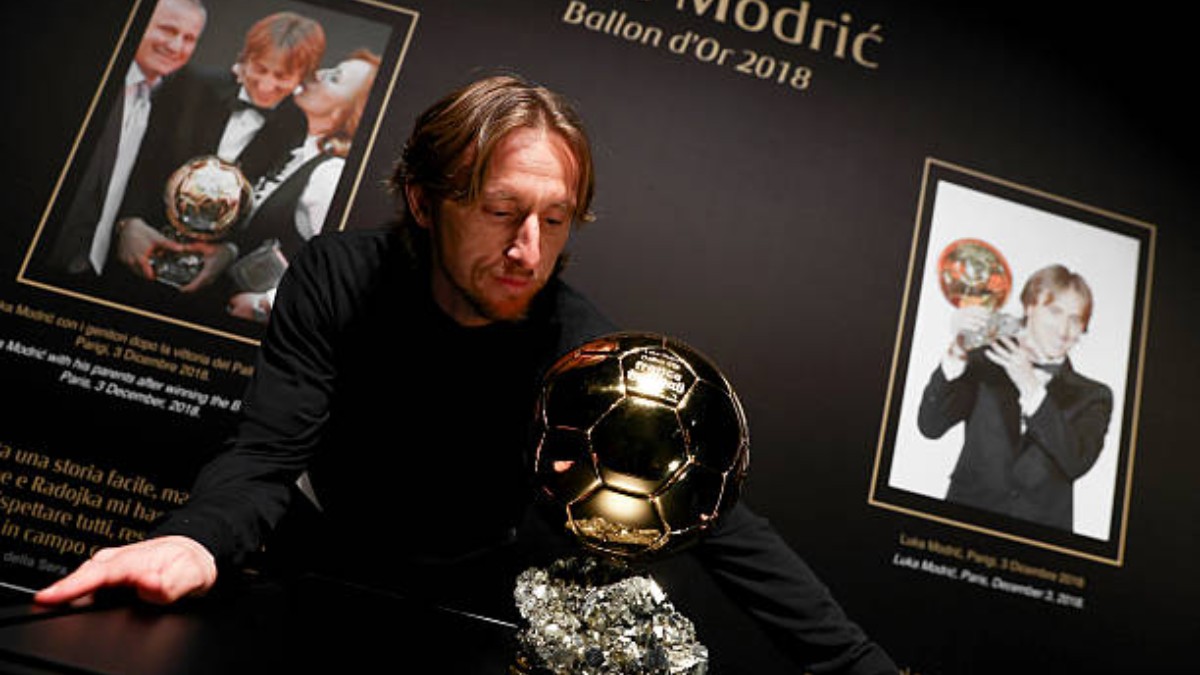
Modrić was named the best player of the World Cup, and then won the Ballon d'Or, the award for the world's best footballer. That same year, he also received FIFA and UEFA awards for the best player.
He became the first Croatian footballer to win the Ballon d'Or, adding his name to the list of the greatest recipients of this prestigious award in football history.
For many young players, that year is proof that success does not belong only to footballers who score the most goals. A player who understands the game, creates space, links up teammates, and controls the flow of a match can be just as important and decisive.
The Croatian national team: the captain who led the Vatreni
Modrić made his debut for the Croatian national team on March 1, 2006. In the years that followed, he became one of its most important players, and then its captain.
His role came especially to the fore at the World Cups. In Russia in 2018, he led Croatia to the silver medal, while four years later in Qatar, he was one of the key players in the team that won bronze.
Two World Cup medals four years apart represent an exceptional achievement for a country the size of Croatia. Modrić also showed that he could maintain top form across several major tournament cycles.
In 2023, Croatia also reached the final of the Nations League, where they lost to Spain on penalties.
Modrić became Croatia's all-time appearance record holder. According to the Croatian Football Federation, in 2026 he surpassed the 200-appearance mark for the Vatreni.
His international career has thus become a story of longevity, responsibility, and a constant desire for new challenges.
Milan: a new chapter in a remarkable career
After an extraordinarily successful spell at Real Madrid came to an end, Modrić began a new chapter in his career with Italian club Milan in 2025. Joining one of Europe's most famous clubs showed that even after turning 40, he had no desire to give up competing at the highest level.
At Milan, he continued to bring experience, technical quality, and composure to the midfield. His role is reflected not only in his precise passing and control of the game, but also in his day-to-day work, which shows his younger teammates what a professional approach to football means.
In July 2026, Milan announced that his contract had been extended until June 30, 2027. Luka is continuing his active career even after achieving the kind of success most footballers can only dream of.
### Interesting facts and records that set Luka Modrić apart
Modrić's career is full of achievements that show just how special his journey has been.
- 2018 Ballon d'Or – the first Croatian footballer to win this prestigious award.
- Six Champions League titles – he won six European titles with Real Madrid, placing him among the few players to achieve this feat.
- 28 trophies with Real Madrid – he ended his career in Madrid as the most decorated player in the club's history in terms of total trophies won.
- Two World Cup medals – silver in 2018 and bronze in 2022.
- Most appearances for the Croatian national team – he became the record holder for the number of matches played for the Vatreni.
- Longevity at the highest level – even after turning 40, he continues to play for one of Europe's most famous clubs.
Still, statistics cannot fully explain his value. Modrić stands out for the way he plays. He does not always have to run the fastest or touch the ball most often. All he needs to do is receive it at the right moment and make a decision that can change the course of a match.
The secret to his success: talent, hard work, and character
Luka Modrić did not become one of the best midfielders in the world overnight. His career developed gradually, through different clubs, loan spells, adjustments, and periods when he had to prove that he belonged at the highest level of football.
His story is especially important for young footballers because it shows that physical build does not have to determine a player's ultimate potential. Technique, vision, balance, intelligence, concentration
 AFT Hrvatska
Da li ste znali za...