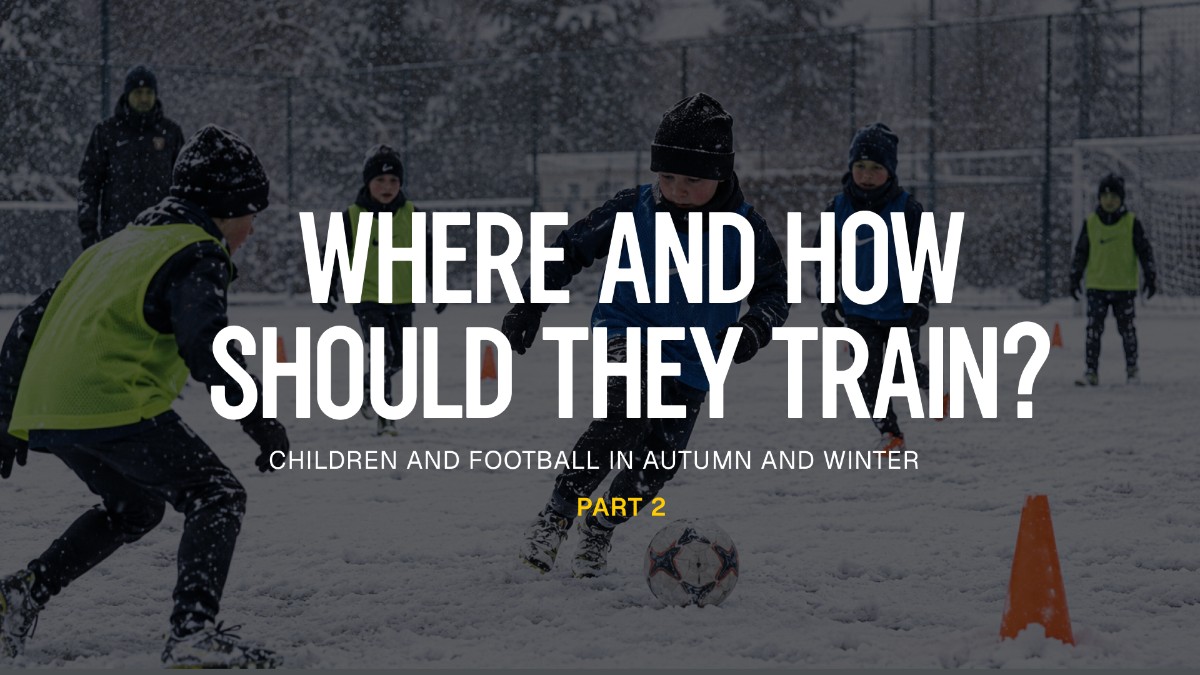
With the arrival of autumn and winter, football schools and coaches face the same question: how should training be organized when temperatures drop, days get shorter, and rain, wind, dampness, and occasional snow make working on an outdoor pitch more difficult?
While some believe that children should train outdoors in almost all weather conditions, others advocate moving into indoor domes or sports halls as soon as the first cold weeks arrive.
Parents, on the other hand, are often concerned about whether being out in the cold is healthy for their children and whether training indoors is a safer option.
However, the question is not a simple one, and there is no single solution that is best for every football school, every age group, and all weather conditions.
The real goal is neither to have children train outdoors at all costs nor to keep them completely off the football pitch during the winter. The goal is to ensure at all times that children are safe, active, motivated, and able to continue developing their football and motor skills through play.
1. WHAT CHANGES WHEN AUTUMN AND WINTER ARRIVE?
Training in October and November does not have to be organized in the same way as training in January or February. The difference is not just the air temperature.
The condition of the pitch, the amount of daylight, the ability to warm up, the choice of equipment and, especially, the way the coach schedules activities all change.
With children aged 6 to 12, it is important to pay particular attention to the fact that they are not scaled-down versions of adult athletes. Their needs, experience, ability to assess how they feel, and individual sensitivity to cold can vary considerably.
In practice, the autumn and winter period brings several important tasks for coaches:
• adapt training to the actual weather conditions, not just the calendar;
• reduce unnecessary standing around and waiting in line;
• provide a thorough, gradual warm-up;
• adjust the duration and intensity of individual activities;
• pay attention to clothing, footwear, and spare dry gear;
• maintain continuity in football learning without exposing children to unnecessary risks.
In their guidelines for the winter period, football associations particularly emphasize the need to get children involved in activity from the start of training, avoid long lines, and use brief instructions during activities rather than repeatedly gathering the whole group for explanations.
2. TRAINING ON AN OUTDOOR PITCH – IS THE COLD REALLY A PROBLEM?
Training outdoors has one major advantage: children learn football in the natural environment where the game is mostly played. They have more space to move, learn how the ball behaves on different surfaces, and develop a sense of space, distance, and the movement of teammates and opponents.
For this reason, it would not be justified to give up outdoor training just because autumn has arrived or the temperature is lower than in summer. However, it is essential to distinguish between cold but acceptable weather and conditions in which continuing the training session is no longer a sensible choice.
When can training outdoors be a good option?
If the pitch is safe, there is no dangerous wind, the surface is not icy or excessively slippery, and the children have suitable clothing, outdoor training can continue with some adjustments.
In these circumstances, priority should be given to activities involving plenty of movement and ball contact:
• one-on-one, two-on-two, and three-on-three games;
• dribbling, changes of direction, and feints;
• short competitive activities;
• possession games with small numbers of players;
• finishing with small-sided games.
This kind of organization is useful for reasons beyond the cold. In its general guidelines for ages 6 to 15, FIFA also emphasizes that quality training should be safe, enjoyable, age-appropriate, and organized so that children are actively involved.
What about rain and wind?
Rain alone does not automatically mean that training should be cancelled. However, a combination of rain, low temperatures, wet clothing, and wind can significantly increase heat loss from the body.
In addition, a wet or damaged surface can increase the risk of slipping and falling. Coaches therefore need to assess the whole situation, not just check the temperature on a thermometer.
It is particularly important to watch out for:
• strong gusts of wind;
• freezing rain, ice, and frozen areas of the pitch;
• large, deep puddles, mud, or surfaces on which children lose their footing;
• wet clothing that cannot be changed for dry clothing;
• visibility and pitch lighting;
• the ability to quickly move to a safe indoor space.
During thunderstorms and dangerous weather conditions, training MUST be stopped or postponed.
In such circumstances, safety takes precedence over the training plan. The same applies when strong winds or heavy precipitation pose an immediate danger.
How should training be adapted in cold weather?
The first rule is that children should not arrive at the pitch and then stand around for several minutes while the coach sets up cones or explains the program.
The training area should be prepared in advance, and children should be involved in a simple warm-up game right away. This could be a game of tag, dribbling through an obstacle course, short one-on-one contests, or ball-based coordination activities.
Long theoretical explanations, waiting in lines, and exercises where one player works while the others watch should be kept to a minimum. If the weather worsens during training, the coach can change the plan and organize several small-sided games.
This way, children stay active, get plenty of contact with the ball, and apply what they have learned in a game.
Clothing is part of preparing for training
Parents and coaches should work together to ensure children have appropriate gear. Layers of clothing that can be added or removed as needed are recommended, along with protection from wind and rain when conditions call for it.
A spare dry shirt and socks can be very useful.
It is important that children do not start training already chilled, but also that they are not overdressed and sweating excessively in unsuitable clothing.
Coaches should monitor the children and watch for shivering, unusual sluggishness, loss of coordination, or complaints about the cold.
There is no single universal temperature that determines whether all outdoor training sessions are allowed or prohibited.
The decision must take into account the temperature, wind chill, precipitation, the condition of the surface, clothing, and each child's individual needs.
If there is any doubt about safety, the training should be adapted, moved indoors, or cancelled.
 Razvoj dece
Edukacija