FROM AN IDEA TO AN INTERNATIONAL FOOTBALL FESTIVALThe story of the Dragan Mance Cup began with the idea of preserving the memory of Partizan’s legendary striker through an organized competition for the youngest footballers.
What began as a project dedicated to one great name gradually grew into an international sporting event, recognized for its large number of participants, the arrival of renowned clubs, and its ambition to provide young footballers with conditions worthy of a serious competition.
The Sports Association “CUP DRAGAN MANCE,” headed by Goran Mance, the legendary footballer’s brother, plays an important role in the tournament’s development.
His personal connection to the family’s memories, along with years of organizational work, gives the event a special dimension: the tournament preserves Dragan’s memory while building a sporting tradition of its own.
The tournament was first held in 2016, and each edition since then has shown that there is great interest from clubs and football schools in Serbia and abroad.
Year after year, the number of participants, international representation, and organizational demands have grown. More and more teams wanted to be part of an event that brings together sporting competition, camaraderie, and the memory of one of Partizan’s most beloved footballers.
The tournament’s growth was not based solely on increasing the number of registered teams. The organizers paid special attention to playing conditions, the quality of the pitches, the fairness of the competition, and the experience young footballers take home with them.
This approach is one of the reasons why the event has managed to establish a distinctive identity on the international football scene.
ZEMUNELO – THE TOURNAMENT’S FOOTBALL HOMEOne of the symbols of the Dragan Mance Cup is the “Teleoptik – Partizan” Sports Center in Zemun, also known as Zemunelo. This complex makes it possible to hold a large number of matches in one location, with natural and artificial turf pitches and infrastructure suited to a multi-day tournament.
For an international competition of this scale, logistics are just as important as football itself. Scheduling matches, organizing referees, registering participants, communicating with clubs, arranging accommodation for visiting teams, and publishing results promptly all require serious preparation and coordination.
At the Dragan Mance Cup, the competition is organized across several age categories, from the youngest teams up to U12. This format allows children of different ages to gather in the same setting and gives teams the chance to test themselves against their peers from other communities and football schools.
It is especially valuable that much of the program takes place within a single sports complex. Participants thus have the opportunity to watch matches in other age groups, meet peers from different countries, and experience the atmosphere of a major football event.
GROWTH BEST SEEN IN THE NUMBERSThe development of the Dragan Mance Cup can perhaps best be tracked through the number of participants, the countries they come from, and the scale of the competition program. The eighth edition of the tournament, in 2024, brought together as many as 288 teams from four continents.
This response confirmed that the event has long since outgrown its local roots and attracts clubs from different parts of the world.
A year later, the ninth edition was held from June 13 to 15, 2025. A total of 240 teams from 15 countries gathered in Zemun, and approximately 700 matches were played across 14 pitches.
The competition featured five categories, while the finals attracted large numbers of parents, supporters, and other football fans.
A special moment in the tournament’s history was its milestone tenth edition, held from June 12 to 14, 2026. The organizers reached the maximum number of registered teams – 248 teams from 17 countries, and the tournament brought together more than 3,000 young footballers.
These figures place the Dragan Mance Cup among international youth football events that require a serious organizational system, extensive infrastructure, and long-term cooperation with clubs from different countries.
EUROPEAN FOOTBALL GIANTS IN ZEMUNOne reason the Dragan Mance Cup attracts attention is the quality of the clubs that have taken part in its editions.
Among the best-known names associated with the tournament are
the Dutch club AJAX from Amsterdam, Portugal’s BENFICA, Italy’s BOLOGNA, Greece’s PAOK from Thessaloniki, Hungary’s FERENCVÁROS, Romania’s DINAMO from Bucharest, and Slovenia’s MARIBOR.
Numerous other clubs and academies from Europe and the region have also taken part.
The arrival of football schools of this caliber is significant in several ways. For the youngest players, it is an opportunity to compete against peers who train in different systems, discover different styles of play, and gain experience that regular local competitions cannot fully provide.
For coaches, the tournament offers an opportunity to compare coaching methods and assess the development of their own teams. For the organizers, the participation of renowned clubs confirms international interest and brings an added responsibility to maintain the event’s quality.
Serbian football is also strongly represented. Partizan, Čukarički, OFK Beograd, Zemun, and other football schools from Serbia have the opportunity to test themselves against visiting teams from abroad on home soil.
However, the tournament’s significance is not limited to famous names. Each edition also brings together numerous smaller clubs, regional academies, and football schools that get the opportunity to introduce themselves to a wider sporting audience through competitions like this.
The combination of major European academies and clubs that develop football at the local level is precisely one of the Dragan Mance Cup’s distinguishing features.
THE MILESTONE 2026 EDITION: AFRICA, ASIA, EUROPE, AND AUSTRALIA IN A FOOTBALL STORYThe tournament’s tenth edition was special not only because of the milestone but also because of its international lineup. Teams from 17 countries confirmed their participation, including Serbia, Russia, the Netherlands, Italy, Australia, Turkey, Greece, Hungary, North Macedonia, Bosnia and Herzegovina, Montenegro, Romania, Poland, Slovenia, Switzerland, Slovakia, and Bulgaria.
The arrival of teams from such diverse footballing backgrounds turns the tournament into much more than a series of matches. Children meet peers who speak other languages, train in different conditions, and come from different cultures, but they are united by one thing – a love of football.
For the milestone edition, the organizers also introduced features that further enrich the participants’ experience. These included live broadcasts of matches via the BravoSine platform and an album of collectible stickers featuring the participants, designed as a keepsake for children to hold on to even after the tournament ends.
Special attention was also paid to the tournament’s symbols. The trophies have been used since the first edition, while the medals are made especially for this event.
Such details may not determine the results on the pitch, but they contribute to the event’s identity and help build a tradition that participants recognize.
SPORTING RESULTS AND MOST MEMORABLE MOMENTS
In the 2014 age group, or U12, the Dutch side
AJAX defeated Partizan 3–1 in the final and took the trophy back to Amsterdam.
In the 2015 age group, the Šabac-based academy
TIKA TAKA delivered one of the tournament’s biggest surprises. After strong performances in the knockout stages, they defeated Italy’s
BOLOGNA 3–0 in the final.
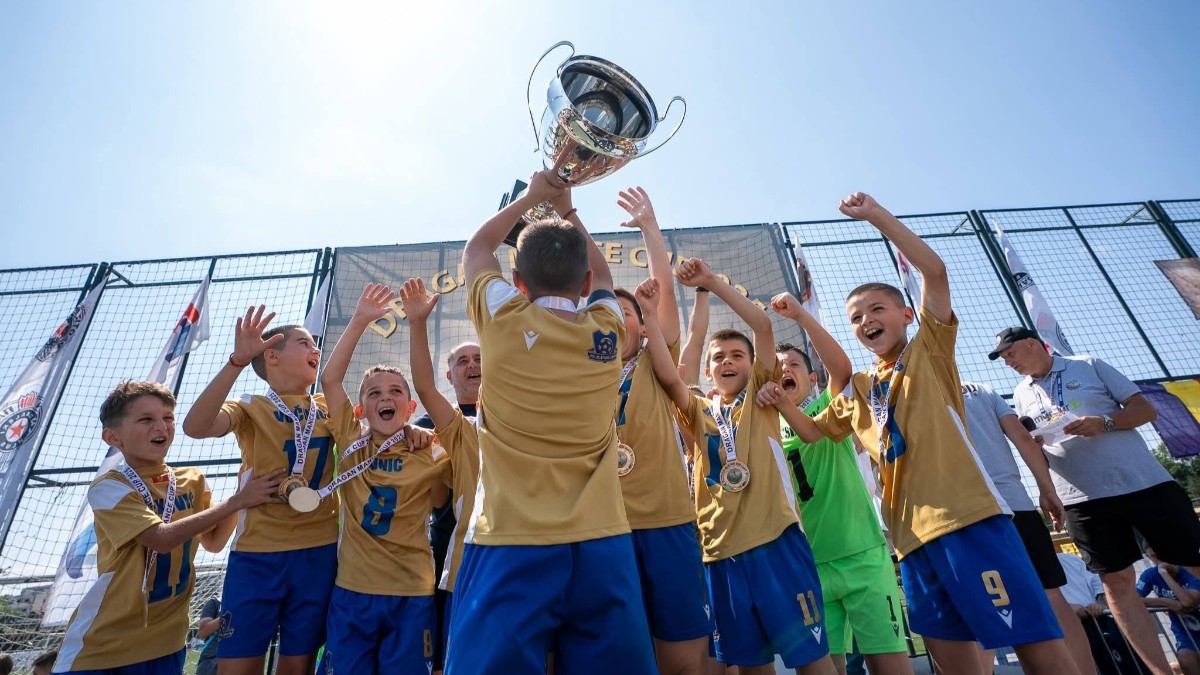
In the 2016 age group, Partizan came out on top. The Black-and-Whites beat Kalimero 5–0 in the final and won the trophy in front of their home crowd.
In the 2017 age group, Greece’s PAOK beat Partizan 4–2, while in the youngest category, the 2018 age group, WINNER defeated Zemun Polje in a penalty shootout. The final ended 2–2 in regular time, with the winner decided by penalties.
These results show how successful a range of different football schools were at the same tournament. The trophies went to the Netherlands, Šabac, Belgrade, and Greece, while the youngest category delivered a dramatic finale decided on penalties.
RECORDS THAT SHOW THE SCALE OF THE TOURNAMENTThe Dragan Mance Cup has several striking statistics that deserve a special place in its history.
Record number of teams: 288 teams at the eighth edition in 2024.
International reach: 17 participating countries at the milestone 2026 edition.
Scale of the competition: approximately 700 matches over three days at the ninth edition in 2025, using 14 pitches.
Scale of the milestone edition: more than 3,000 young footballers at the tenth edition in 2026.
Early registration closure: registration for the milestone 2026 edition closed as early as March, three months before the tournament began, after the maximum number of 248 teams had been reached.
THE DRAGAN MANCE CUP AND AFT: ENTERING THE ELITE TOURFor AFT, the Dragan Mance Cup is a tournament of special importance. Its international reputation, number of participants, quality of the clubs, infrastructure, and organizational standards make it one of the most recognizable events on the youth football calendar.
In the 2026/27 season, the tournament holds
AFT ELITE TOUR status, the highest rank in the system of the Association of Football Tournaments.
This status is more than a formal recognition. The Elite Tour brings together tournaments that stand out for their organizational quality, international participation, the reputation of their participants, and the overall standard of the event.
In the AFT system, a tournament’s rank also determines how many points teams can earn on their way to the top of the national and regional rankings.
At Elite Tour competitions, the winner of each age group earns 150 AFT points, the runner-up earns 100, and the third-place team earns 80 points. Teams that progress to subsequent stages of the competition also earn points, in accordance with the ranking rules.
For this reason, the Dragan Mance Cup has a dual significance for clubs. On the one hand, winning the trophy is an achievement at one of the highest-quality international tournaments for youth age groups.
On the other hand, success earns points that can significantly affect a club’s position in the AFT rankings during the season.
For clubs planning their 2026/27 season, it is especially important to follow the official AFT calendar and the organizers’ announcements. As an Elite Tour event, the Dragan Mance Cup will be an important stop for teams looking to compete against strong international opposition and earn a large number of AFT points.
MORE THAN A TOURNAMENT – A MEMORY THAT ENDURESThe history of the Dragan Mance Cup shows how a sporting event can grow around a memory while building an identity and tradition of its own. From the original idea to the hundreds of teams that now come to Zemun, the tournament has become a meeting place for different football schools, cultures, and generations.
For some participants, their greatest memory will be winning a trophy. For others, it will be a match against a renowned European club, a new friendship, or their first appearance at a major international tournament.
For coaches, it will be an opportunity to assess their players’ progress, and for parents, a moment of pride that will be remembered long after the result itself.
And for all of them, the name Dragan Mance remains a reminder of a footballer who left a deep mark on Partizan’s history with his talent and energy.
That is precisely why the tournament’s greatest value lies in the combination of two stories: the memory of the man whose name it bears and the future of the children who are just beginning to write their own football stories on its pitches.
With AFT ELITE TOUR status, international participation, and ten editions behind it, the Dragan Mance Cup is entering a new chapter in its history. In the years ahead, its challenge will not only be to set new records, but also to preserve what makes it special: the quality of football, organizational excellence, international friendship, and a memory passed down from one generation to the next.
 Elite tour
AFT Ranking
AFT Srbija