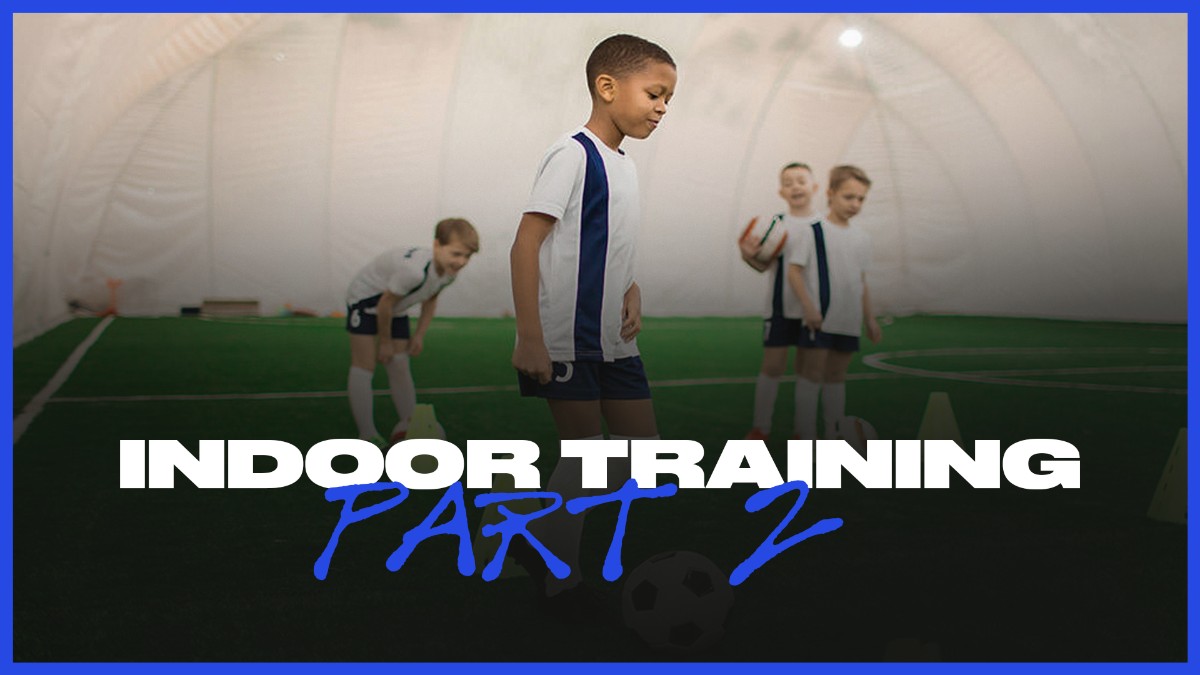
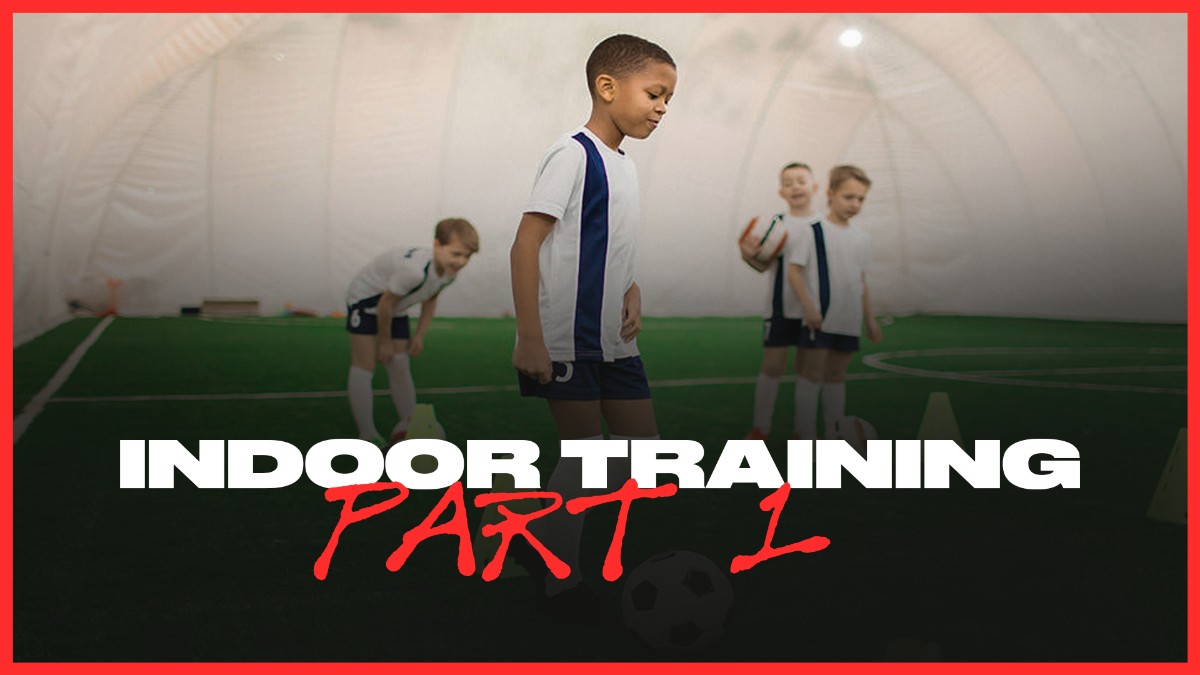
7. COORDINATION AND BALANCE – A MAJOR ADVANTAGE OF INDOOR TRAINING
Limited space can be an excellent opportunity to develop coordination.
The coach can use agility ladders, hoops, cones, small hurdles and various visual cues.
However, we should not forget that coordination is not just about moving your feet quickly through the ladder. It involves a child’s ability to coordinate movements, control their body, respond to changing situations and perform a specific task correctly.
That is why exercises that combine the following are especially useful:
• movement and dribbling the ball;
• changing direction on a signal;
• body control after stopping;
• reacting to an opponent;
• maintaining balance in different positions;
• coordinating movements with football skills.
Ideally, the child should not be thinking only about how to perform the exercise, but should also have to observe, make decisions and react at the same time.
8. ADVANTAGES AND DISADVANTAGES OF INDOOR TRAINING
ADVANTAGES
• Training can take place regardless of rain, snow or low temperatures.
• It is possible to maintain continuity throughout the year.
• Children get more touches on the ball.
• Technique, coordination and decision-making speed are developed.
• Small-sided games encourage creativity and independent problem-solving.
• The coach can more easily organize individual work and small groups.
• Children can be introduced to elements of futsal.
DISADVANTAGES AND LIMITATIONS
• Not enough space for long sprints and developing maximum speed.
• Fewer opportunities to practice long passes and play in a large space.
• The ball moves and bounces differently than on grass.
• There is a risk of excessive strain on joints and muscles if the surface and activity intensity are not taken into account.
• A limited number of children can train effectively at the same time.
• There may be ventilation and temperature issues in inflatable domes.
• Costs of renting facilities and limited training times.
It is important to understand that none of these advantages or disadvantages has to be decisive. It all depends on how training is organized, the quality of the facility and the coach’s expertise.
9. THE MOST COMMON COACHING MISTAKES
When working with children indoors, several common mistakes should be avoided.
First mistake – copying outdoor training sessions.
Exercises that work well on a full-size pitch may not be suitable in a small hall. The coach must adapt the space, number of players and intensity.
Second mistake – too much waiting and standing around.
If ten children are waiting in a single line to perform an activity, a large part of the training session will be wasted. Multiple stations and parallel activities should be organized.
Third mistake – too many exercises without the ball.
Football is a game played with a ball. Physical conditioning is important, but it should not displace technical and tactical development.
Fourth mistake – neglecting the playing surface and footwear.
Inappropriate footwear, a slippery floor or damaged artificial turf can increase the risk of injury.
Fifth mistake – training at too high an intensity.
Indoor spaces often encourage fast, dynamic activities. However, the coach must monitor the children’s fatigue, movement quality and need for rest.
Sixth mistake – not allowing enough time for play.
Children come to football to learn, but also to play. A training session without enough play is unlikely to keep them motivated.
10. CONCLUSION – THE WINTER PERIOD AS AN OPPORTUNITY TO MAKE FURTHER PROGRESS
Indoor training should not be viewed as a necessary evil or a temporary solution until conditions are suitable for returning to the outdoor pitch.
When organized properly, it can be a very important part of a young footballer’s development.
An inflatable dome and sports hall provide children with the opportunity to improve their ball control, technique, coordination, reaction speed and decision-making ability.
At the same time, small-sided games and carefully planned physical activities can help maintain and develop a significant part of their motor and fitness abilities.
However, coaches must understand that indoor spaces cannot fully replace all the conditions provided by a full-size football pitch. Therefore, the best approach is to combine different types of training in line with the players’ age, goals and abilities.
In the end, the most important thing is that children do not lose their routine, motivation and enjoyment of training, because a successful winter period is not one in which children have simply maintained their fitness, but one in which they have learned something new, become more confident on the ball and taken another step in their football development.
 Razvoj dece
Edukacija