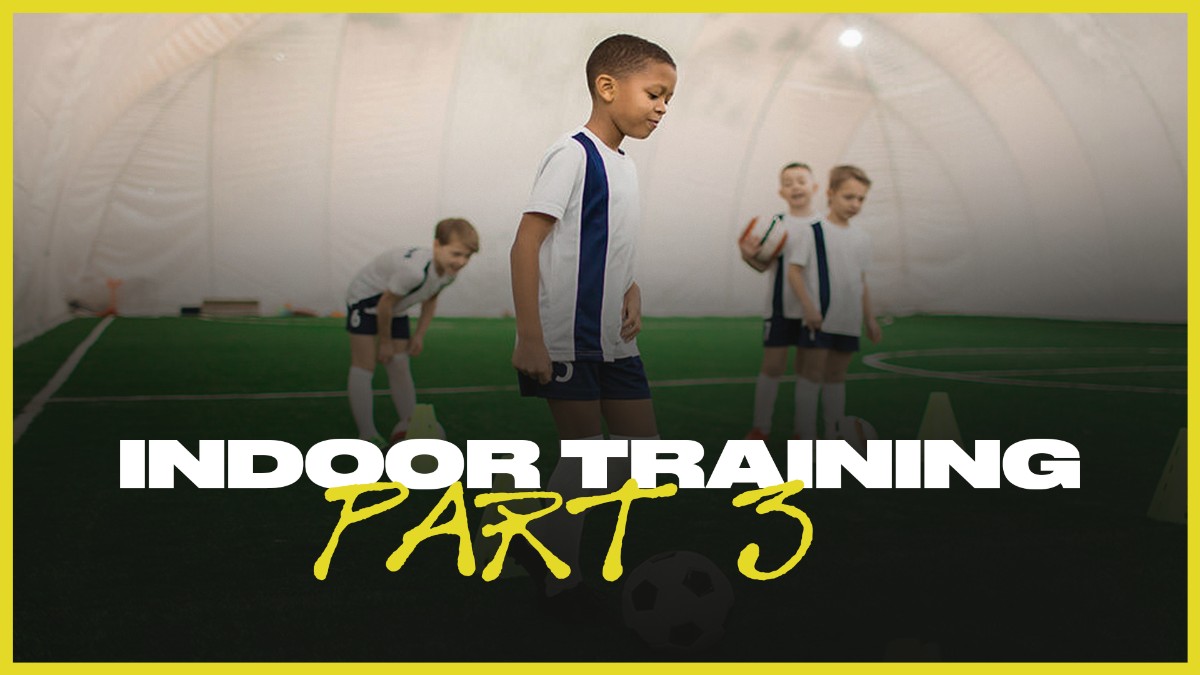
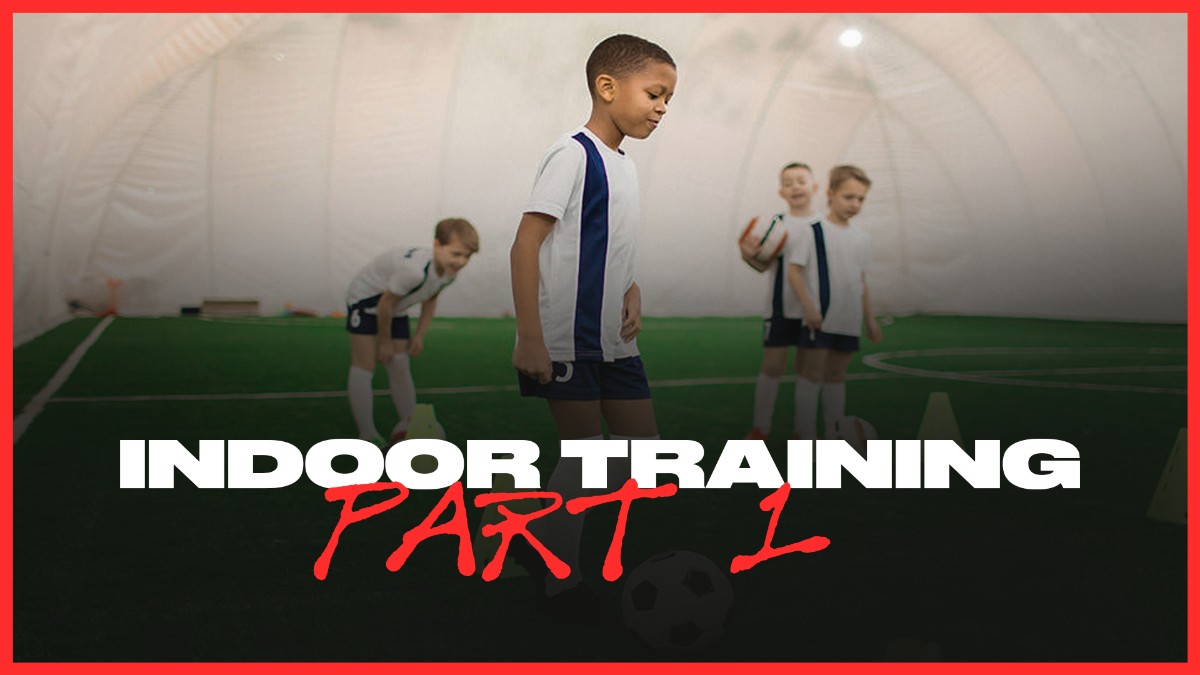
An indoor dome with artificial turf is usually the closest substitute for a regular football pitch.
Advantages:
• allows the use of familiar football patterns;
• is suitable for dribbling, passing, and small-sided games;
• allows training in different game formats;
• can be used throughout the year, regardless of weather conditions.
What should you pay attention to?
The coach must check the quality and condition of the artificial turf, the evenness of the surface, any damage, and whether conditions are safe for movement.
It is particularly important that footwear is suitable for the specific type of artificial turf.
The temperature and ventilation of the dome should also be taken into account, since intensive training in an enclosed, warm space can increase the strain on the body.
INDOOR SPORTS HALL WITH A WOODEN FLOOR
A wooden floor creates completely different conditions. The ball moves faster along the surface, and its bounce may differ from that on grass.
This makes it particularly suitable for developing short passes, quick receptions, ball control, and play in tight spaces.
Advantages:
• excellent conditions for improving short-passing play;
• development of coordination and balance;
• faster decision-making;
• a high number of touches on the ball;
• the opportunity to introduce children to elements of futsal.
However, a wooden floor requires special care. Footwear must be designed for indoor sports, with a suitable sole that does not slip or leave marks.
Cleats or shoes with studs are not recommended. Uncontrolled challenges, sudden stops, and changes of direction that children are not yet able to perform properly should also be avoided.
SPORTS RUBBER AND OTHER SURFACES
Some sports halls have rubber or other synthetic surfaces. Their characteristics depend on the material, firmness, elasticity, and quality of construction. Some may provide better impact absorption, while others may be harder or more slippery.
Coaches should not assume that every rubber surface is automatically safer than a wooden floor or artificial turf.
The most important thing is to know the characteristics of the space, check the condition of the surface, and adapt the training accordingly.
4. THE BALL AND FOOTWEAR – TWO IMPORTANT DETAILS
Coaches often use the same ball indoors as they do on an outdoor pitch. This is not always the best solution. On a wooden floor, a standard football may bounce much more than is ideal for training in a small space.
For this reason, a futsal ball, which has a reduced bounce, is often a better choice.
It allows for better work on receiving, control, and short passes. Of course, children should also occasionally train with a standard football, as we do not want them to completely lose their feel for its characteristics.
Footwear should be selected according to the surface:
• for wooden floors – suitable indoor sports shoes;
• for artificial turf – footwear designed for the specific type of surface;
• for other synthetic surfaces – footwear recommended by the facility’s manufacturer or qualified professionals.
Choosing the right footwear is not just a matter of comfort, but also of controlling movement and staying safe.
5. HOW CAN YOU MAINTAIN AND IMPROVE TECHNIQUE?
One of the biggest advantages of indoor training is the opportunity to devote a great deal of attention to individual ball work. On an outdoor pitch, there is often more space, larger groups, and different dynamics.
Indoors, a coach can organize drills in which every child has a ball and gets a large number of repetitions.
Particular attention should be given to:
• receiving the ball in different situations;
• controlling the ball under pressure;
• using the weaker foot;
• short and accurate passes;
• changes of direction;
• dribbling and feints;
• quickly identifying open space.
It is very useful not to practice technical skills only in isolation, but to transfer them into the game as soon as possible. For example, a child may dribble the ball through cones ten times, but it is much more important for them to learn when, why, and how to change direction in a real match.
That is why technical drills should be linked to one-on-one and two-on-two situations, as well as small-sided games.
6. FITNESS, SPEED, AND ENDURANCE – CAN CHILDREN MAINTAIN THESE INDOORS?
They can, with proper planning. One common misconception is that indoor training cannot be physically demanding enough.
Small-sided games, short work intervals, changes of direction, and high-intensity games can provide an excellent stimulus for developing certain physical abilities.
However, it is important to understand that different types of training develop different abilities. A three-on-three game can be very demanding in terms of endurance, coordination, and acceleration, but may not provide enough space to develop maximum speed.
It is therefore useful to combine:
Aerobic endurance: through longer intervals of play, continuous activities with the ball, and suitable small-sided games.
Acceleration: through short sprints on a safe surface, with enough room to stop.
Agility: through changes of direction, reactions to signals, and games in which the child must react quickly.
Explosiveness: through simple, age-appropriate jumps, take-offs, and short bursts of acceleration.
Muscular stability: through balance exercises, body control, and correct execution of basic movements.
It is particularly important not to insist on a high number of repetitions or on training to exhaustion at all costs. For children, movement quality is much more important than quantity.
 Razvoj dece
Edukacija