When we talk about the most important names in Slovenian football, Srečko Katanec holds a very special place.
A former Yugoslav international, winner of major European honors, and coach who wrote the most important chapters in the history of the Slovenian national team, he left a lasting mark on football in the former Yugoslavia, as well as on the European stage.
His story is not simply one of a successful playing career. It is the story of a footballer who competed in the biggest international tournaments, won trophies in Italy and Germany, and then, as a coach, achieved something that had until then seemed almost unattainable – he took Slovenia to two major international tournaments, the European Championship in 2000 and the World Cup in 2002.
FROM LJUBLJANA TO THE BIG YUGOSLAV FOOTBALL STAGE
Srečko Katanec was born on July 16, 1963, in Ljubljana. He started playing football at a very early age, joining NK Ljubljana when he was just seven.
His talent soon became apparent, and in 1981 he moved to Ljubljana-based Olimpija, where he spent the next four years and confirmed that he was one of the most promising footballers of his generation.
The next stop in his career was Dinamo Zagreb, whose colors he wore from 1985 to 1986. He then joined Partizan Belgrade, where Katanec continued to build a reputation as a talented and dependable midfielder.
With Partizan, he won the Yugoslav league title in the 1986/87 season. This was an important achievement in his career, as well as the beginning of his journey to Europe’s strongest football leagues.
GERMANY AND ITALY – YEARS OF MAJOR TROPHIES
In 1988 Katanec moved to German club VfB Stuttgart. In his first season with the new club, he reached the UEFA Cup final, where Stuttgart faced Napoli.
The Italian side, managed by Diego Maradona, came out on top in both legs, but reaching a European final was an important achievement for the German club and its Slovenian footballer.
After just one season in Germany, Katanec moved in 1989 to Sampdoria of Genoa. It was at this Italian club that he achieved some of the greatest successes of his playing career.
In a Sampdoria shirt, he won the UEFA Cup Winners’ Cup in the 1989/90 season, followed by the Italian league title in the 1990/91 season. Sampdoria had an exceptionally talented squad at the time, one that left a lasting mark on Italian and European football.
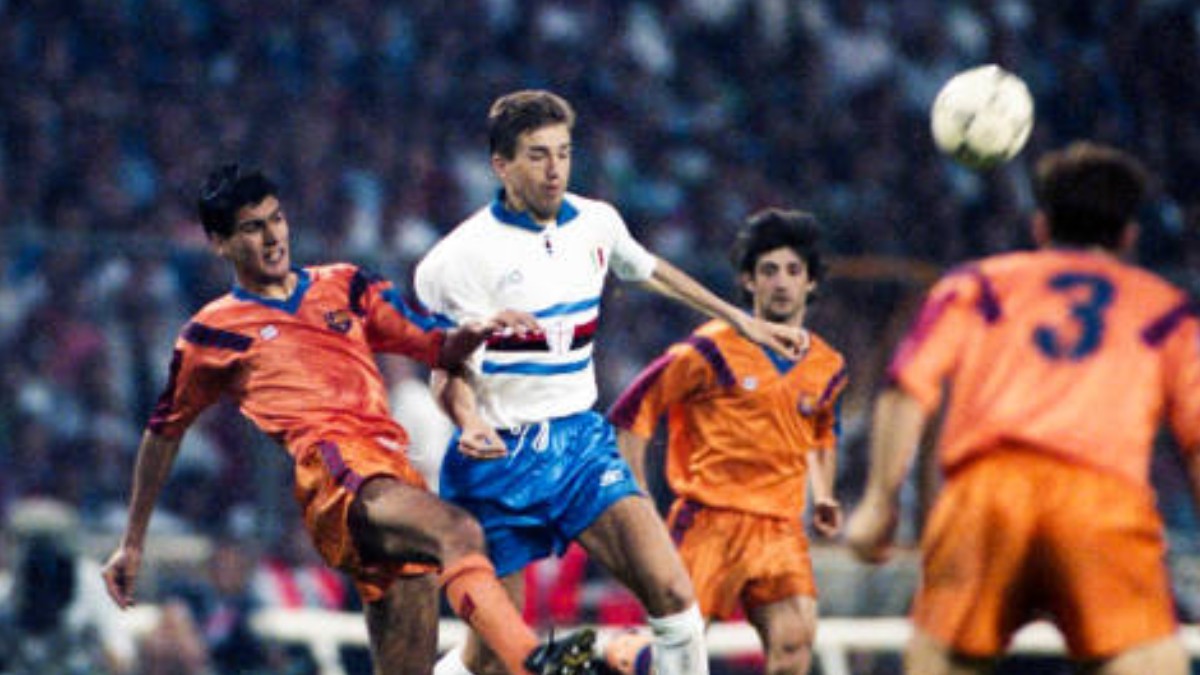
The 1991/92 season stands out in particular, when the Genoa club reached the European Cup final. In the showpiece final at London’s Wembley Stadium, Sampdoria lost 1–0 to Barcelona. The match was decided in extra time, when Ronald Koeman scored the only goal.
Katanec also won the Italian Super Cup in 1991 and the Italian Cup in the 1993/94 season with Sampdoria. According to official club records, he played 129 matches and scored 17 goals for Sampdoria.
INTERNATIONAL CAREER – FROM YUGOSLAVIA TO SLOVENIA
Katanec was an important member of the Yugoslav national team, for which he made 31 appearances and scored five goals.
He represented Yugoslavia at the 1984 European Championship in France and the 1990 World Cup in Italy. The Olympic tournament in Los Angeles in 1984, where he won a bronze medal with the Yugoslav team, also holds a special place in his sporting career.
After Slovenia gained independence, he also represented his homeland. Due to an injury, he made only five appearances in a Slovenian shirt, but one of them was especially significant – the match against Italy in Maribor on September 7, 1994, in which he scored his only goal for Slovenia.
Even so, his greatest contribution to Slovenian international football was yet to come.
FROM PLAYER TO COACH – THE BEGINNING OF A HISTORIC STORY
After retiring as a player, Katanec turned to coaching. He worked with Slovenia’s younger national teams and also gained experience at NK Gorica.
On July 1, 1998, he took over as head coach of the Slovenian senior national team. At the time, the team had just come through a very unsuccessful qualifying campaign for the 1998 World Cup in France, earning just one point.
Katanec managed to change the atmosphere, improve the team’s organization, and build a national side that began to believe in its abilities.
The first major result came in qualifying for the 2000 European Championship, hosted by Belgium and the Netherlands. Slovenia finished second in its qualifying group, behind Norway, and secured a place in the playoffs.
The opponent was Ukraine, a team with considerably more international experience and prestige. Nevertheless, Katanec’s team won 2–1 in Ljubljana and then drew 1–1 in Kyiv. Slovenia thus qualified for the European Championship finals for the first time in its history.
EURO 2000 – SLOVENIA SHOWED IT COULD COMPETE WITH THE BEST
At the 2000 European Championship, Slovenia competed in Group C alongside Yugoslavia, Spain, and Norway.
In their very first match against Yugoslavia, Katanec’s players put on one of the tournament’s most thrilling performances. Slovenia took a 3–0 lead, with Zlatko Zahović scoring twice and Miran Pavlin adding the other goal. Yugoslavia nevertheless managed to fight back, and the match ended 3–3.
Slovenia lost 2–1 to Spain in its next match, then drew 0–0 with Norway in the final round. The team’s tournament ended in the group stage, but simply qualifying for the European Championship was a historic achievement for Slovenian football.
For a small footballing nation that had only begun building its own international identity a few years earlier, it was an enormously significant moment.
2002 WORLD CUP – ANOTHER ACHIEVEMENT THAT MADE HISTORY
If qualifying for the European Championship was the first major sign of progress, the qualifying campaign for the 2002 World Cup showed that Slovenia’s success was no fluke.
In a very challenging qualifying group that also included Russia, Yugoslavia, and Switzerland, Slovenia finished second and once again secured a place in the playoffs.
This time, the opponent was Romania. Slovenia won the first match 2–1 in Ljubljana, while the return leg in Bucharest ended 1–1. The 3–2 aggregate score secured Slovenia’s second consecutive qualification for a major international tournament.
Katanec thus became the coach who took Slovenia to both the European Championship and the World Cup, marking the country’s greatest achievement in international football up to that point.
At the 2002 World Cup in Japan and South Korea, Slovenia competed in Group B alongside Spain, Paraguay, and South Africa. The team did not progress beyond the group stage, but simply qualifying for the World Cup was a historic achievement that will forever be part of Slovenian football history.
After the tournament, Katanec concluded his first term as head coach.
RETURN TO THE SLOVENIAN SIDELINE AND CONTINUING HIS COACHING CAREER
After his first term as head coach, Katanec continued his coaching career abroad. He managed Greece’s Olympiacos, then went on to coach the national teams of North Macedonia and the United Arab Emirates.
At the beginning of 2013, he returned to the Slovenian sideline and began his second term as head coach. He led the team in qualifying for the 2014 World Cup and the 2016 European Championship. In qualifying for EURO 2016, Slovenia reached the playoffs but did not manage to secure a place in the final tournament.
Katanec thus remained an important part of Slovenian football history once again, not only because of the results he achieved, but also because he was the coach who opened the door for the national team to compete on European and world football’s biggest stages.
THE MAN WHO PUSHED THE BOUNDARIES OF SLOVENIAN FOOTBALL
Looking back at Srečko Katanec’s career today, we see a footballer who won trophies in some of Europe’s strongest leagues, an international who competed at the European Championship and the World Cup, and an Olympian who won a bronze medal.
But perhaps his most important legacy is his work as head coach. At a time when Slovenia was still establishing its place on the international football scene, Katanec managed to build a national team that believed it could compete with the best.
His story reminds us that the strength of a footballing nation does not depend solely on its population or the size of the country. Much depends on knowledge, hard work, organization, unity, and confidence in one’s own abilities.
For young footballers, coaches, and everyone involved in developing children’s football, Srečko Katanec’s career is a reminder that great results do not happen overnight. They are the product of years of work, quality development, and the ability to recognize and make the most of the potential every team has.
 AFT Slovenija
Da li ste znali za...